SDGs still offer best option to reduce worst impacts of COVID-19 and to recover better

What Could COVID-19 Mean for Sustainable Development?
NEW YORK, 22 June 2020—Countries will be better placed to recover from the human and economic devastation caused by COVID-19 by accelerating efforts to achieve the Sustainable Development Goals (SDGs), according to a policy briefissued by the United Nations Department of Economic and Social Affairs (UN DESA) today.
While it is still unclear what the ultimate effect of the coronavirus will be, the initial assessments are sobering, with enormous losses of lives and livelihoods. The death toll, at close to half a million, is still climbing.
Initial assessments show that there are immense risks to failing to act swiftly and in a coordinated manner. Global GDP is expected to contract by 5.2 per cent in 2020, the largest contraction in economic activity since the Great Depression, and far worse than the 2008-2009 global financial crisis. In 2020 alone, millions of people—estimates range from around 35 to 60 million—could be pushed into extreme poverty, reversing the declining global trend of the last twenty-plus years. Some 1.6 billion people working in the informal sector including the gig economy are estimated to be at risk of losing their livelihoods, many of whom lack access to any form of social protection.
An additional 10 million of the world’s children could face acute malnutrition, and the number of people facing acute food insecurity could almost double relative to 2019, rising to 265 million. School closures have affected over 90 per cent of the world’s student population—1.6 billion children and youth. More detailed data on the world’s sustainable development efforts will be announced on 7 July in the Sustainable Development Goals Progress Report 2020.
Decisions taken now on whether to return to the pre-pandemic world or to one that is more sustainable and equitable will help shape future outcomes. The policy brief warns that if coronavirus responses are ad-hoc, underfunded and without a view to long-term goals, decades of progress toward sustainable development stand to be reversed.
Alternatively, as countries begin to move towards recovery, the brief states that “the thoughtful and targeted actions can place the world on a robust trajectory towards achieving the SDGs.”
Past progress toward achieving many of the goals is a factor in lessening the severity of impacts on lives and economies. For example, achieving SDG 6—access to clean water—is necessary to enable people to wash one’s hands regularly, which is one of the top virus-repelling strategies recommended by the World Health Organization. SDG 11, which calls for sustainable cities and communities, has proven critical for reducing the exposure to the virus for those living in crowded places or without access to basic services. And SDG 3 concerns the need to address pre-existing health conditions such as non-communicable diseases, which have been identified as a major factor in more severe COVID cases.
Past progress in promoting decent work (SDG 8), increasing access to quality health care (SDG 3) and ensuring internet access for school and work (SDG 9) help mitigate the severity of adverse impacts.
The policy brief contends the key concern of the SDGs—to leave no one behind—must be central to planners and decision makers while developing COVID-19 recovery policies. These policies should be created with an eye towards protecting vulnerable groups including young people who face unemployment, children who have no access to online learning opportunities, and women, who face a disproportionate increase in the burden of care work as well as greater risk of domestic violence.
The SDGs can serve as preventive medicine against future shocks, but responses will have to deviate far from business as usual, using this pause to adopt more equitable and sustainable ways forward.
For instance, with oil prices at historic lows and employment in the sector shrinking, we can initiate a just transition for workers to the green economy while cancelling fuel subsidies and introducing carbon taxes.  This could set the stage for meeting the most ambitious goals of the Paris Agreement on climate change while also achieving the SDGs.
To ward off the worst effects of COVID-19, countries should prioritize action in three areas:   protecting progress already made towards the SDGs, accelerating the universal provision of quality basic services, and maintaining the environmental gains of this period to reverse trends in the degradation of nature.
The brief concludes that it is still possible to realize the global goals but that greater coherence and coordination of national actions are required, as well as a stronger global partnership for development. In addition, the UN system must stand ready to facilitate progress in all these areas.
Why we cannot lose sight of the Sustainable Development Goals during coronavirus

While we must scale up the immediate health response to curb the spread of COVID-19, the response to the pandemic cannot be de-linked from the SDGs, write the Prime Minister of Norway and President of the Republic of Ghana.

From reversing progress on good health (SDG 3) to the negative impact on 1.25 billion students (SDG 4), the pandemic is affecting vulnerable societies the most.

Erna Solberg is the Prime Minister of Norway and Co-chair of the UN Secretary-General’s SDG Advocates

Nana Addo Dankwa Akufo-Addo is the President of the Republic of Ghana and Co-chair of the UN Secretary-General’s SDG Advocates

Our world today is dealing with a crisis of monumental proportions. The novel coronavirus is wreaking havoc across the globe, upending lives and livelihoods. The cost of the pandemic in terms of loss of human lives is painful, but the effects on the global economy and on sustainable development prospects are also worrying. The International Monetary Fund estimates that our world has entered into a recession, and while the full economic impact of the crisis is difficult to predict, preliminary estimates place it at US$2 trillion.

The pandemic has exposed fundamental weaknesses in our global system. It has shown how the prevalence of poverty, weak health systems, lack of education, and a lack of global cooperation exacerbate the crisis.

If there was any doubt that our world faces common challenges, this pandemic should categorically put that to rest. The crisis has re-enforced the interdependence of our world. It has brought to the fore the urgent need for global action to meet people’s basic needs, to save our planet and to build a fairer and resilient world. We face common, global challenges that we must solve through common, global solutions. After all, in a crisis like this we are only as strong as the weakest link. This is what the Sustainable Development Goals (SDGs), the global blueprint to end poverty, protect our planet and ensure prosperity, are all about.

Sadly, this pandemic hit at a time when the SDGs were gaining traction and a significant number of countries were making good progress. As the world is seized with containing the spread of the virus and addressing its negative impacts, the reality is that countries are resetting their priorities, and reallocating resources to deal with the pandemic. This certainly is the right thing to do because the priority now is to save lives, and we must do so at all costs.

That is why we must all support the call by the United Nations to scale up the immediate health response to suppress the transmission of the virus, end the pandemic and focus on people particularly, women, youth, low-wage workers, small and medium enterprises, the informal sector and vulnerable groups already at risk. Working together we can save lives, restore livelihoods and bring the global economy back on track.

But what we cannot afford to do, even in these crucial times, is shift resources away from crucial SDG actions. The response to the pandemic cannot be de-linked from the SDGs. Indeed, achieving the SDGs will put us on a firm path to dealing with global health risks and emerging infectious diseases. Achieving SDG 3 (Good Health) will mean strengthening the capacity of countries for early warning, risk reduction and management of national and global health risks.

This pandemic has exposed the crisis in global health systems. And while it is severely undermining prospects for achieving SDG 3 by 2030, it is also having far-reaching effects on all other SDGs.

Emerging evidence of the broader impact of the crisis on our quest to achieve the SDGs is troubling. UNESCO estimates that some 1.25 billion students are affected, posing a serious challenge to the attainment of SDGs Goal 4 (Quality Education); and the International Labour Organisation (ILO) estimates some 25 million people could lose their jobs, with those in informal employment suffering most from lack of social protection. Unfortunately, these are just the tip of the iceberg.

Crucially, in many parts of the world, the pandemic and its effects are exacerbated by the crisis in achieving clean water and sanitation targets (SDG 6), weak economic growth and the absence of decent work (SDG 8), pervasive inequalities (SDG 10), and above all, entrenched poverty (SDG 1) and food insecurity (SDG 2). The World Bank estimates the crisis will push some 11 million people into poverty.

Even at this stage in the pandemic, we cannot deny the fact that the crisis is teaching us, as global citizens, the utmost value in being each other’s keeper, in leaving no one behind, and in prioritising the needs of the most vulnerable.

What is acutely needed is enhanced political will and commitment. Our world has the knowledge, capacity and innovation, and if we are ambitious enough, we can muster the resources needed to achieve the Goals. Buoyed by the spirit of solidarity, Governments, businesses, multi-lateral organisations and civil society have in the shortest possible time been able to raise billions, and in some cases, trillions to support efforts to combat this pandemic. If we attach the same level of importance and urgency to the fight against poverty, hunger, and climate change, we will find success in this Decade of Action on the SDGs.

As the world responds to this pandemic and seeks to restore global prosperity, we must focus on addressing underlying factors through the Sustainable Development Goals. We must not relent our efforts, even amid this crisis. While some SDG gains have been eroded, this should not deflate our energy. They should rather spur us to accelerate and deepen our efforts during this Decade of Action to ‘recover better’, and build a healthier, safer, fairer and a more prosperous world.

Maheen Khan

My expertise revolve around Multi-sectoral Policy & Programming, Disaster Recovery & Rehabilitation Planning and Project Management. I have contributions, made towards designing and implementing project documents, M&E Frameworks, development of Minimum Standards, humanitarian coordination (NoC &MoU Management) for UN donor funded/NGO programs including Policy level Agreements on Education, Volunteerism, Health, Women/Child Protection Programs, Disaster Management with United Nations UNV. The programs range from working in Public Policy, Regular Development to Conflict & Complex Emergencies.

With COVID-19, the SDGs are evenmore important

This year, the first of the new decade, was meant to be the start of something big.
As 2020 started, we tipped into the ‘decade of delivery’ to eliminate extreme
poverty and achieve the Sustainable Development Goals (SDGs) by 2030. It also
marked an unexpected era as COVID-19 hit the world have been
grappling with the pandemic and its devastating aftershocks ever since. But
instead of sidelining the Goals, COVID-19 has made the SDGs even more relevant.
The SDGs offer us an integrated perspective to combat this crisis. In the 2030
Agenda we have a holistic framework that brings the global economic,
environmental and development agendas together for the first time. Because they
are so broad and complex – the very thing they are often criticised for – the SDGs
can help us understand and respond to the wide-ranging impacts of COVID-19.
So COVID-19 should not be an excuse to delay action, but rather reason to
accelerate action on the SDGs.
SDGs as a framework for understanding COVID-19 impacts
COVID-19 started as a health crisis, but quickly snowballed into an economic
crisis and is now a burgeoning humanitarian crisis as well. We are only just starting to truly understand the scale and scope of its impacts.

By early June, a Reuters tally showed more than 400,000 people had died
worldwide from COVID-19, with the spread far from contained in many parts of
the world. Other regions are already experiencing a second wave of infections.
The International Labour Organization estimates nearly half of the world’s
workforce – 1.6 billion people – risk losing their livelihoods due to the ‘great
lockdown’. According to the IMF’s latest World Economic Outlook, the cumulative
loss to global GDP over 2020 and 2021 could be about US$9 trillion, greater than
the combined economies of Japan and Germany. In the Asia-Pacific alone, the
drop in global demand is estimated to slash US$172 billion from trade. The
economic impacts of the virus are projected to force an additional 40 million to
500 million people into poverty. World Vision estimates that the lives of 30 million
children are at risk from COVID-19 health aftershocks, as malaria and
malnutrition go untreated due to overstretched health systems. In April, school
closures in more than 190 countries forced at least 1.57 billion students from
classrooms. There are fears many of these students may be lost to the education
system entirely, becoming more vulnerable to child labour, trafficking and child
marriage.
The flow-on effects are so extensive that they are difficult to comprehend.
One framework that brings these diverse aspects together – from poverty rates, to
economic growth, to education, to health – is the Sustainable Development Goals.
The 17 Goals, and their 169 targets and 232 indicators, are a unique tool to help
governments, businesses and NGOs understand the full scope of complex policy
challenges like COVID-19. The United Nations Department of Economic and
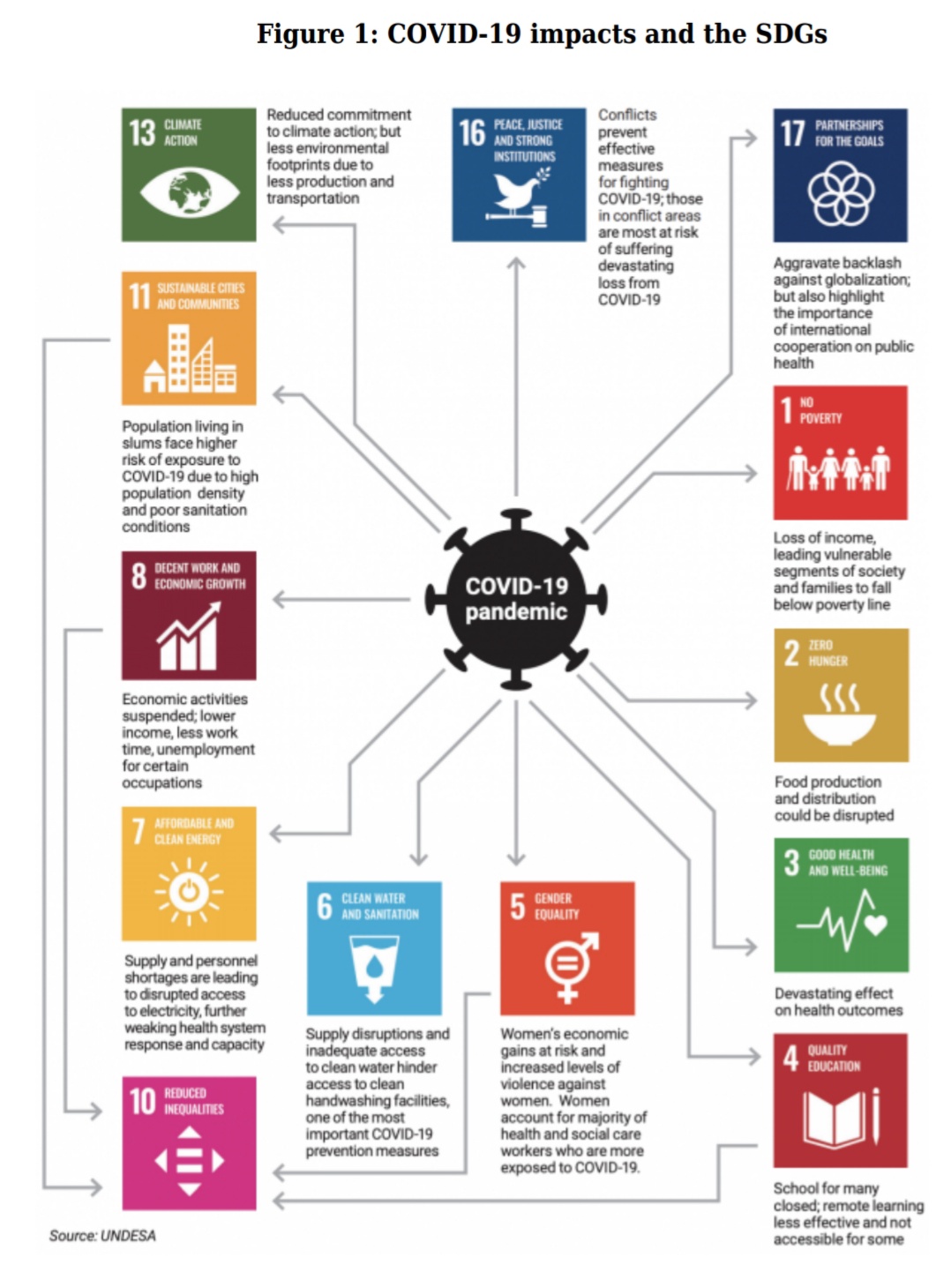
Social Affairs has conceptually mapped how COVID-19 affects each of the SDGs,
from disruption to food supplies (SDG 2) to increased levels of violence against
women (SDG 5). This conceptual mapping, while simple, shows the value of the
SDGs as a framework for understanding the intersecting flow-on effects of
COVID-19.

SDGs as a roadmap to recovery from COVID-19
The SDGs are not only useful for understanding COVID-19, they are also a
valuable tool to guide the national and international recovery effort. In the SDGs
we have a blueprint to not only address health security, but to address food,
economic and climate security as well. This is important because we don’t want to
step from one crisis straight into another.
The pandemic has exposed weaknesses in the international system that need to be
addressed as part of the ‘build back better’ agenda. The past couple of months
have shown how poverty (SDG 1), weak health systems (SDG 3), inadequate water
and sanitation (SDG 6), and substandard international cooperation (SDG 17) have
exacerbated the COVID-19 crisis. In the SDGs we have a comprehensive
framework to address these risk factors holistically to build resilience to current
and future shocks, whether they be health, economic or environmental shocks.
That is why, for example, World Vision’s global response to COVID-19 is not only
limiting the spread of the virus, but supporting food security, education, and
livelihoods as well.
Importantly, we now have an opportunity to fast-track sustainable development by
ensuring recovery plans are aligned with the SDGs. The massive fiscal stimulus
that is being deployed around the world can be used to both address COVID-19
impacts and accelerate the SDGs. The development trajectory that will be forged
in the coming months will have significant implications for generations to come.
The underlying principle of the SDGs is to leave no one behind. This should be a
hallmark of the national and global recovery effort. According to the UN, the cost
of protecting the most vulnerable 10% of people from the worst impacts of
COVID-19 is about US$90 billion – or 1% of the combined stimulus packages of
OECD and G20 countries (estimated at about $9 trillion).

7SDGs as a vision for a post-COVID world
The SDGs paint the picture of a world free from poverty by 2030, where there is
universal access to healthcare, education, water and sanitation. It is a resilient
world which would be in a much stronger position to withstand shocks like
COVID-19. Had the international community invested more in the SDGs earlier,
we may have been in a better position to manage the current crisis.
The vision for 2030 outlined in the SDGs may seem unreachable, but the political
will and amount of stimulus being mobilised to combat COVID-19 demonstrate
that, when push comes to shove, humanity can step up to deal with complex
global challenges. The SDGs must be pursued with the same decisiveness,
solidarity, urgency and commitment that we are seeing in the fight against
COVID-19. Only then can the vision for a world free from poverty be realised.

From trade-offs to synergies: COVID-19, populism, and sustainable development

Concerns are growing that the COVID-19 crisis could be exploited by populists claiming to be the voice of those who have been ‘left behind’. This column presents a new framework which could help shed light on the relationship between sustainable development and populism. Progress on the Sustainable Development Goals may be associated with diminishing electoral support for populism, but humanity must still get better at turning the trade-offs between SDGs into synergies. During the COVID-19 recovery, an effective way to prevent populists from exploiting the crisis may involve making the SDGs the policy blueprint. 

In the academic literature, as well as within the VoxEU debate, a number of reasons for the recent rise of populism have been brought forward (for an overview of the literature, see Norris and Inglehart 2018). However, no study has yet looked systematically at the relationship between the rise of populism on the one hand, and the historic Agenda 2030 for Sustainable Development on the other. To address this gap, we recently introduced the first systematic classification of Sustainable Development Goals (SDG) performance and populism (Kroll and Zipperer 2020). We performed the first empirical analysis of the relationship between populism and the SDGs by examining how countries have progressed on the SDGs over time, and how their development in terms of sustainability relates to subsequent electoral support for populism. We used data from the SDG Index and Dashboards (Sachs et al. 2019 and www.sdgindex.org) which provides “the most comprehensive picture of national progress on the SDGs and offers a useful synthesis of what has been achieved so far” (Nature Sustainability 2018).  

Towards a virtuous cycle of SDG progress

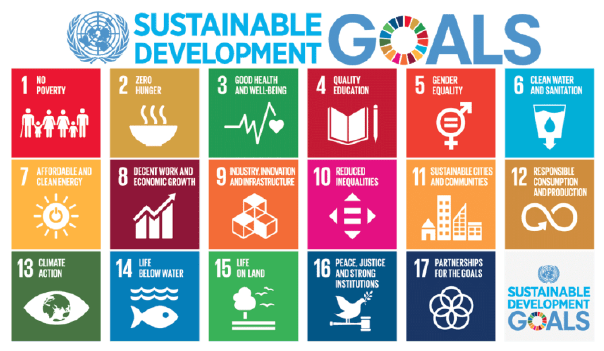
The SDGs provide a new and enlarged understanding of sustainability as an economic, social, and environmental challenge. The goals are firmly rooted in the concept of sustainable development, i.e. “development that meets the needs of the present without compromising the ability of future generations to meet their own needs” (Brundtland Commission 1987, Sachs 2015). They comprise 17 goals and 169 targets that span a range of topics, from ending extreme poverty (SDG 1) to affordable and clean energy (SDG 7), or a global partnership for the goals (SDG 17) (UN 2015) (see Figure 1).

Source: UN (2015)

What makes pursuing the SDGs a particularly challenging task is the fact that these goals have, at present, antagonist tendencies among themselves. In other words, there are numerous trade-offs between SDGs, such as between reducing poverty and climate action, which, in the future, will need to be turned into mutually reinforcing synergies in order to achieve a “virtuous cycle of SDG progress” (Kroll et al. 2019). Colleagues and I have performed a first analysis of future interactions for projected SDG trends until 2030 within and between goals. We analysed how trade-offs and synergies have evolved globally in the recent past. We found an alarming inability to overcome certain persistent trade-offs, as well as the deterioration for some SDGs. These findings seriously threaten the achievement of the Agenda 2030 (ibid).

A new Sustainability–Populism Framework

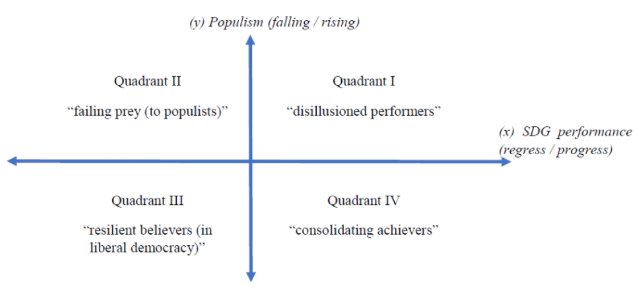
In order to enable a structured and fine-grained interpretation of the nexus between sustainability and populism in future research and policy debate, we have recently proposed a Sustainability–Populism Framework (Kroll and Zipperer 2020, see Figures 2 and 3). It elaborates on the four possible outcomes for the relationship between SDG performance over time, and subsequent electoral support for populism.

Figure 2 The new Sustainability–Populism Framework 

  • Quadrant I: “disillusioned performers” (SDG improvement, rising populism). The countries named “disillusioned performers” have been making progress towards the SDGs. However, populist parties were able to gather increased support (e.g. by capitalising on potential fear of regress or scapegoating towards minorities). 
  • Quadrant II: “failing prey (to populists)” (SDG deterioration, rising populism). Countries in this category have been failing to advance on the SDGs, and they are falling prey to populists and the political recipes they propose.
  • Quadrant III: “resilient believers (in liberal democracy)” (SDG deterioration, falling populism). Even though the situation with regard to the SDGs has deteriorated over the last years, countries in this group keep their faith in traditional mainstream parties and the solutions they propose to overcome the challenges. 
  • Quadrant IV: “consolidating achievers” (SDG improvement, falling populism). These countries have been making progress towards the SDGs, and the calls by populists to steer in a different direction are not heeded by voters.

The SDGs as an answer to populism

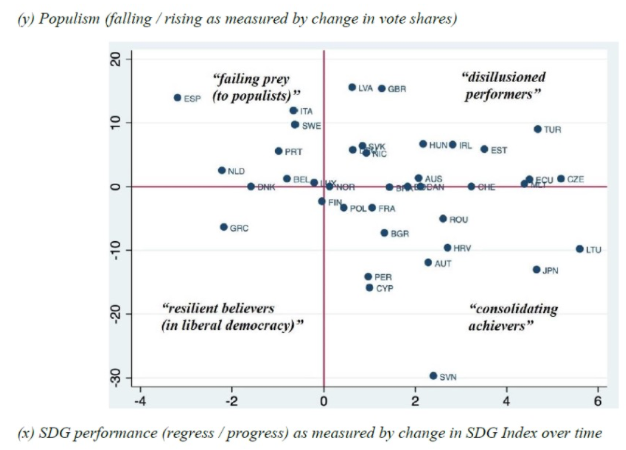
For illustrative purposes of the framework’s analytical value, we examined data on SDG progress and populist vote shares that were available for 39 countries (SDG progress data for 2010 – 2015). Although, due to a time lag, the raw data sometimes precede that period; populist vote share data represent the change from second-last to last election, with the last election mainly taking place between 2015 and 2018 (for details, see Kroll and Zipperer 2020). Most countries fall into Quadrant I and IV. In other words, while most of the countries examined have experienced progress towards the SDGs, they differ in terms of whether the electorate has subsequently turned to populists or not. A number of countries have also experienced SDG regress, and subsequently seen an increase in electoral support for populists (Quadrant I). Almost no countries can be found in Quadrant III, with Greece being an exception where possibly a disillusionment with populists has meant that voters turned away from them. An additional analysis for each SDG separately can be found in the paper.

In order to further explore the nature of the statistical relationship between the two concepts beyond the aforementioned framework, we also performed a linear regression analysis. We thereby examined the SDG performance over time as a potential determinant of the populist vote share in the subsequent election. We find a significant negative effect of overall SDG country performance over time on the change in populist vote share (controlling for GDP per capita change PPP). For each one-point increase on the aggregate SDG Index (out of 100), the vote share of populist parties on average drops by about two percentage points. We also find significant negative effects of progress in SDG 1 (No poverty), SDG 2 (Zero hunger), SDG 11 (Sustainable cities and communities), and SDG 15 (Life on land). The effect sizes vary as follows. For each one-point increase on the SDG 1 indicator (out of 100), the vote share of populist parties on average drops by about 0.3 percentage points, while for SDG 2 it drops by about 2.4 percentage points. For SDG 11, the drop is by about one percentage point, and for SDG 15 by about half a percentage point. 

Figure 3 The Sustainability–Populism Framework with data for 39 countries 

Making the SDGs the blueprint for the COVID-19 recovery

As countries are now beginning to organise the recovery after COVID-19, many commentators have expressed concerns that the hardship associated with the crisis might be exploited by populists in numerous countries, potentially leading to a new wave of electoral support for populism. The lessons from recent findings discussed here lend support to the notion that a strong commitment to the SDGs (overall, as well as in particular to the SDGs 2, 11, and 15) could be part of an appropriate and effective answer to populism. The SDGs would therefore be a very suitable blueprint for the COVID-19 recovery. 

References

Brundtland, G (1987), “Report of the World Commission on Environment and Development: Our Common Future”, United Nations General Assembly, document A/42/427.

Kroll, C, A Warchold and P Pradhan (2019), “Sustainable Development Goals: Are we successful in turning trade-offs into synergies?”, Palgrave Communications (doi: 10.1057/s41599-019-0335-5)

Kroll, C and V Zipperer (2020), “Sustainable Development and Populism”, Ecological Economics, forthcoming (doi:10.1016/j.ecolecon.2020.106723)

Norris, P and R F Inglehart (2018), Cultural Backlash: Trump, Brexit, and Authoritarian Populism, New York:  Cambridge University Press.

Sachs, J (2015), The Age of Sustainable Development, New York: Columbia University Press.

United Nations (2015), “Transforming our world: The 2030 agenda for sustainable development”.